Sultanahmet
The historic heart of two empires
Scores
Sultanahmet is, without question, Istanbul's most iconic neighborhood and one of the most historically dense places on Earth. Situated at the tip of the historic peninsula, this district is the epicenter of the city's Byzantine and Ottoman heritage, a place where every stone tells a story stretching back more than fifteen hundred years. For travelers visiting Istanbul for the first time, Sultanahmet is the perfect starting point — the place where the great monuments of history line up within a radius of just a few hundred meters.
Waking up in Sultanahmet, the first thing you'll hear is the ezan, the call to prayer resonating from the minarets of the Blue Mosque. It's a sound that defines Istanbul's sonic identity, and in Sultanahmet it reaches a special intensity as the voices of muezzins from several nearby mosques intertwine in a spine-tingling symphony. If you stay in one of the many boutique hotels in the area — many of them housed in restored Ottoman-era mansions — you can enjoy this moment from a terrace overlooking the Sea of Marmara or the mosque gardens.
Hagia Sophia (Ayasofya) is, for many, the main reason to visit Istanbul. This architectural colossus, built in 537 AD by order of Emperor Justinian I, was for nearly a thousand years the largest cathedral in the Christian world. After the Ottoman conquest of 1453, it became a mosque, and in 1934 Ataturk transformed it into a museum. In 2020, it was reconverted into a mosque, sparking passionate debate but not preventing tourist visits outside prayer times. The dome of Hagia Sophia, at 55 meters high and 31 meters in diameter, remains one of humanity's engineering masterpieces. Upon entering, the light filtering through forty windows at the base of the dome creates an ethereal effect that has amazed visitors for fifteen centuries. The Byzantine mosaics on the upper floor — particularly the Deesis depicting Christ flanked by the Virgin Mary and John the Baptist — are breathtakingly beautiful.
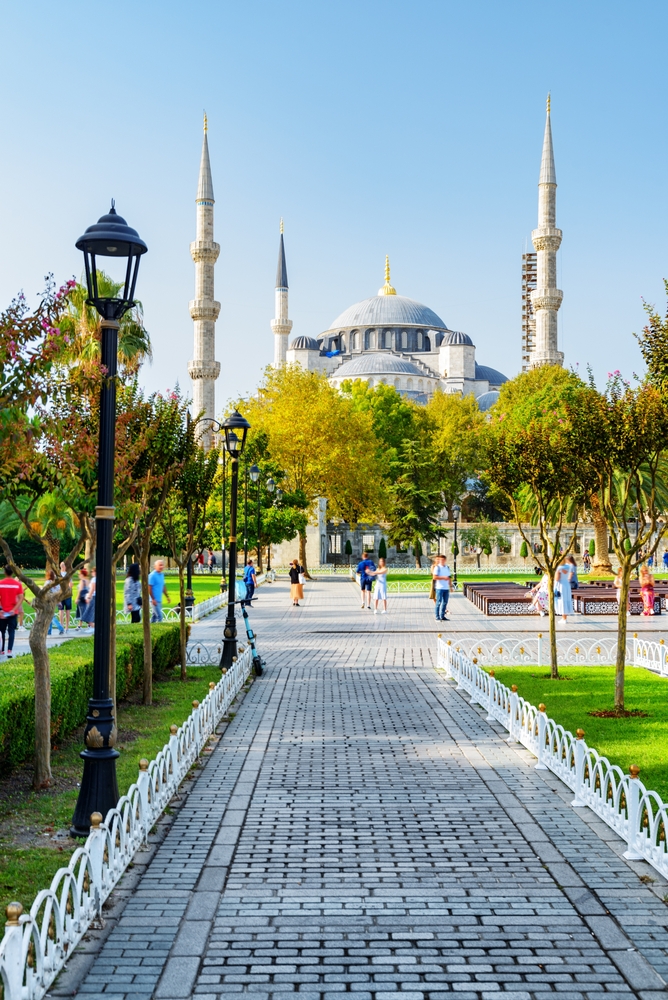
Directly opposite Hagia Sophia stands the Blue Mosque (Sultanahmet Camii), built between 1609 and 1616 by Sultan Ahmed I as a response to Hagia Sophia's splendor. Its popular name derives from the more than twenty thousand Iznik tiles decorating its interior, creating a mosaic of blue tones that gleams with natural light. The mosque is unique in the Islamic world for having six minarets. Visits are free but require respectful dress code and avoiding prayer times.
Between both monuments stretches Sultanahmet Square, the ancient Hippodrome of Constantinople, where Byzantines held chariot races and the Nika Riots nearly toppled Emperor Justinian in 532 AD. Three original monuments remain: the Obelisk of Theodosius brought from Egypt, the Serpent Column from Apollo's temple at Delphi, and the Column of Constantine.
Topkapi Palace (Topkapi Sarayi) occupies a privileged position at the peninsula's tip, overlooking the Bosphorus, the Golden Horn, and the Sea of Marmara. It served as the Ottoman sultans' main residence for nearly four hundred years (1465-1856). The palace is organized around four successive courtyards, each more intimate and luxurious than the last. Must-see sections include the Harem, the imperial kitchens, the Treasury (featuring the 86-carat Spoonmaker's Diamond and the Topkapi Dagger), and the Sacred Relics chamber. Allow at least three hours and book tickets online to avoid long queues.
The Basilica Cistern (Yerebatan Sarnici) is one of Sultanahmet's most fascinating surprises. This enormous underground water reservoir, built by Justinian I in 532, contains 336 marble columns arranged in twelve rows. The atmosphere inside is magical: dim lighting, dripping water, and carp swimming in the shallow pools create a cinematic ambiance. The famous Medusa heads in the northwest corner remain a mystery.
Divan Yolu avenue is Sultanahmet's main artery, connecting the square to the Grand Bazaar along the ancient Byzantine Mese ceremonial route. The walk takes about ten minutes and passes restaurants, carpet shops, and the Column of Constantine (Cemberlitas). The Grand Bazaar itself, with over four thousand shops across sixty-one covered streets, is among the world's largest and oldest covered markets. For a calmer experience, visit the Arasta Bazaar behind the Blue Mosque.
Accommodation in Sultanahmet offers extraordinary variety in boutique hotels housed in restored Ottoman mansions. Many feature rooftop terraces with panoramic views. A good four-star boutique hotel costs EUR 60-120 per night, while luxury options run EUR 150-180.
For dining, distinguish between tourist-trap restaurants in the central zone and authentic establishments. Sultanahmet Koftecisi, founded in 1920, serves simple but delicious grilled meatballs. Matbah offers exceptional Ottoman palace cuisine. Balikci Sabahattin is the area's best seafood restaurant. Be aware of common tourist scams: the shoeshine trick, carpet-shop tea invitations, and unofficial guides. Stay friendly but firm, and use licensed guides.
Transport is excellent thanks to the T1 tram, with Sultanahmet and Gulhane stops connecting to the Grand Bazaar, Eminonu ferries, Karakoy, and Kabatas. The journey to Taksim takes about thirty minutes. Everything within the neighborhood is walkable — Hagia Sophia, the Blue Mosque, the Hippodrome, the Basilica Cistern, and Topkapi Palace are all within five hundred meters.
Morning in Sultanahmet has a special charm. Gulhane Gardens are perfect for a stroll among centuries-old plane trees and springtime tulips. The Turkish and Islamic Arts Museum, in Ibrahim Pasha's former palace by the Hippodrome, houses one of the world's most important collections of Islamic art, including carpets, calligraphy, ceramics, and illuminated manuscripts. Its ethnographic section recreating Ottoman house interiors is particularly engaging.
Akbiyik Caddesi, descending from the Blue Mosque toward the sea, is Sultanahmet's backpacker heart. Budget hostels, family-run guesthouses, restaurants with terrace menus under ten euros, and reasonably priced souvenir shops line this street. It leads down to Cankurtaran, a charming residential neighborhood with wooden Ottoman houses and cobblestone streets descending to the sea walls. At Cankurtaran's end, terrace restaurants overlooking the Sea of Marmara serve fresh fish with sunset views over the Prince's Islands.
The Grand Palace Mosaic Museum, near the Arasta Bazaar, houses fragments of a vast 6th-century mosaic from the Byzantine emperors' Great Palace. Nearby, the Church of Saints Sergius and Bacchus (now Kucuk Ayasofya Camii or "Little Hagia Sophia"), built by Justinian before Hagia Sophia itself, is a less-visited architectural gem with an elegant octagonal plan.
Sultanahmet's nighttime atmosphere is quiet but charming. When shops close and tour groups retreat, the illuminated minarets of Hagia Sophia and the Blue Mosque cast golden light over the square, and the final ezan of the day floats through the warm summer air. Some rooftop hotels organize candlelit dinners against this backdrop, and small bars on Divan Yolu's side streets serve Turkish wine or Efes beer.
For photography enthusiasts, Sultanahmet offers extraordinary opportunities at every hour. Dawn between Hagia Sophia and the Blue Mosque with the empty square bathed in pink light is a premium moment. Midday light play inside the Basilica Cistern is ideal for long exposure work. And sunset views from Gulhane Park toward the Golden Horn, with fishermen silhouetted against the orange sky, complete an unmatched photographic repertoire.
Sultanahmet is ultimately the ideal neighborhood for first-time visitors — an open-air museum breathing history with every step. Its unrivaled concentration of UNESCO World Heritage monuments and the ability to walk through fifteen centuries of history in a compact area make it a unique experience. While nightlife is virtually nonexistent and dining requires some selectivity to avoid tourist traps, the cultural reward is immense. Another aspect worth attention is Sultanahmet's daily religious life. Unlike Istanbul's more secular neighborhoods, here Islam's presence is constant and visible: the ezan sounds five times daily, worshippers regularly attend the Blue Mosque, and during Ramadan the neighborhood transforms with decorative lights between minarets, communal iftar tables, and an atmosphere of reflection and celebration unique to this place. For non-Muslim travelers, experiencing Ramadan in Sultanahmet is an extraordinary cultural window into Turkish spirituality.
Turkish hammams (bathhouses) are another essential Sultanahmet experience. The Ayasofya Hurrem Sultan Hamami, built by architect Sinan in the 16th century for Hurrem Sultan (Roxelana), Suleyman the Magnificent's favorite wife, is among Istanbul's most beautiful bathhouses. Located between Hagia Sophia and the Blue Mosque, it offers traditional Turkish bathing — soaping, kese (silk glove) exfoliation, and foam massage — in an exceptional architectural setting. More expensive than other city hammams, but the combination of history, architecture, and service justifies it.
The Arasta Bazaar behind the Blue Mosque deserves its own mention. This 17th-century market, part of the mosque complex, offers quality handicrafts, Iznik ceramics, and textiles at more reasonable prices than the Grand Bazaar, in a calmer atmosphere. The Mosaic Museum at the bazaar's end holds extraordinary 6th-century floor fragments from the Byzantine Great Palace.
For those interested in Ottoman calligraphy, the Caligraphers Museum near Beyazit Gate showcases centuries of this exquisite art form. And bibliophiles should visit the Sahaflar Carsisi (Book Bazaar), a small open-air market of booksellers that has operated continuously since the Ottoman period, nestled between the Grand Bazaar and Beyazit Mosque.
Sultanahmet is not just a neighborhood: it is the living legacy of two great empires, and every cobblestone has a story to tell.
Highlights
Where to eat
What to see and do
How to get there
Hotels in Sultanahmet
Find the best hotels in Sultanahmet at the best guaranteed price.
See hotels in Sultanahmet